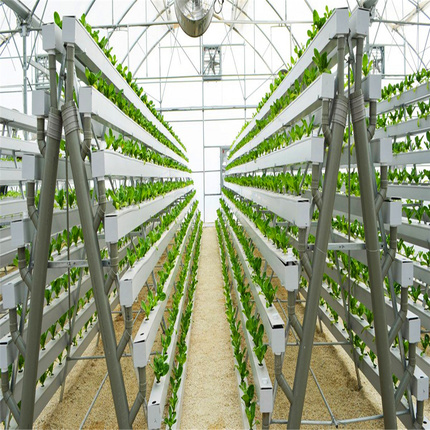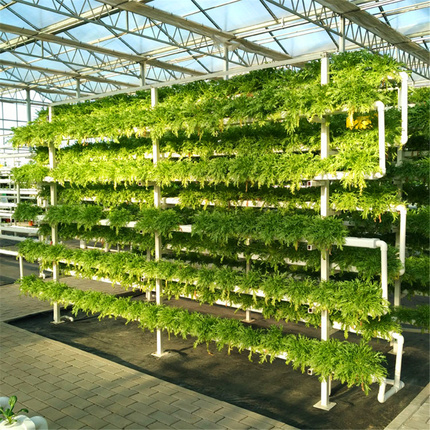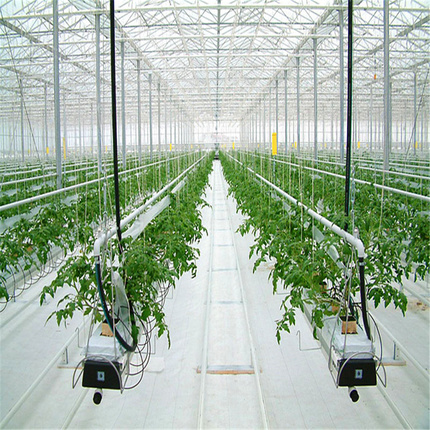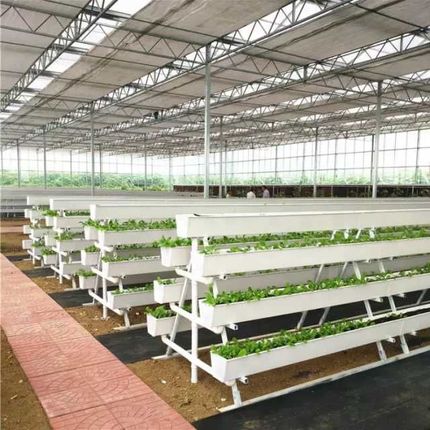
A commercial NFT lettuce greenhouse combines a protected greenhouse structure, NFT growing channels, nutrient circulation, seedling production and climate-control equipment. For tropical and hot-climate farms, the design should place particular attention on ventilation, shading, evaporative cooling, water quality and backup planning for pumps.
| System | Typical planning points |
|---|---|
| Greenhouse structure | Hot-dip galvanized steel frame, project-specific span and bay layout, and PE film or another covering selected for the local climate. |
| Climate control | Roof or side ventilation, insect net, shade net, exhaust fans and cooling pads selected after checking local temperature and humidity. |
| NFT growing system | Food-contact-suitable channels, crop spacing, support frame, return flow, nutrient tanks and circulation pumps. |
| Water and nutrients | Raw-water analysis, filtration, A/B nutrient dosing, EC and pH management, and practical cleaning access. |
| Seedling and operation | Seedling area, transplanting route, packing space, spare parts and daily maintenance plan. |
Plant capacity should not be estimated from greenhouse area alone. A 500-600 m2 greenhouse can use different channel lengths, aisle widths and planting distances. The final number of lettuce positions depends on the usable growing area, channel layout, seedling area, service aisles and packing workflow. NSR Greenhouse prepares the channel layout after confirming the target number of plant positions and the operating method.
High outdoor temperature and humidity can reduce the effectiveness of a cooling system. The proposal should therefore consider the maximum summer temperature, relative humidity, prevailing wind, available water and electricity stability. Shade net, natural ventilation, fan-and-pad cooling and circulation fans should be designed as one coordinated system instead of being selected separately.
Project country, city and delivery port
Available land dimensions and target greenhouse area
Target number of lettuce plant positions or weekly harvest target
Maximum and minimum temperature, humidity, wind and rainfall
Raw-water source and available water analysis
Required systems, automation level and local power supply
Preferred EXW, FOB or CIF quotation basis
Installation plan, delivery schedule and budget range
Yes, but cost reduction should come from a practical layout and carefully selected automation level, not from removing essential structure, cooling, filtration or nutrient-circulation components.
There is no reliable fixed number. Capacity depends on channel spacing, aisle width, seedling area and workflow. A layout drawing is needed before confirming the plant count.
Not always. The decision depends on temperature, humidity, wind and crop schedule. In humid locations, ventilation and shading performance must be assessed together with evaporative cooling.
Please provide the destination port and preferred trade term. Packing size and container quantity can only be confirmed after the structure, channels and equipment list are finalized.
The proposal can include layout drawings, installation drawings, packing list, spare-parts list and online installation guidance according to the agreed supply scope.
Featured planning guide: NFT Lettuce Greenhouse Solution for Tropical Climate Farms
Related buyer resources: Greenhouse shipping and container FAQ | Commercial greenhouse buyer FAQ | Hydroponic greenhouse quotation checklist
Request a preliminary configuration: Send the project location, greenhouse area, target plant capacity, climate data and destination port through the contact page.